
It’s been four years since russia launched its brutal full-scale invasion of Ukraine. Four years is a long time in our fickle news cycles, for attention to turn elsewhere, for audiences to start feeling ‘compassion fatigue’. But the toll of the invasion continues to rise. The UN records more than 15,000 civilian deaths, 41,000 injuries, and 10 million displacements since February 2022.
Alongside this devastating human loss, russia continues its campaign of cultural destruction. As of 11 February 2026, UNESCO has verified damage to 519 cultural sites in Ukraine: 153 religious sites, 270 buildings of historical and/or artistic interest, 39 museums, 33 monuments, 19 libraries, 4 archaeological sites, and 1 archive.
Culture as a Target
This destruction is not a side effect of russia’s invasion, but rather a part of a “deliberate” and “coordinated” strategy on the part of Moscow, according to the European Union’s Culture Commissioner, Glenn Micallef. UN experts cited reports of “demonisation and denigration of Ukrainian culture and identity” coupled with forcible replacement with the russian language, culture, and history. In occupied territories, Ukrainian history books are labeled as “extremist” and destroyed. Teachers who don’t agree with the occupier’s curriculum are swiftly replaced russian counterparts.
russian forces have undertaken a campaign of systematic looting of art and historical artifacts. Ukrainian officials estimate that over 480,000 artworks and artifacts have been taken from dozens of museums since the start of the full-scale invasion in February 2022. The Kremlin has amended museum legislation, integrating Ukranian museums into its network and effectively prohibiting the return of looted Ukrainian artifacts.
As Oksana Semenova, a Ukrainian cultural historian, explains, “the destruction and appropriation of culture is a weapon of war. By erasing memory and stealing heritage, occupiers attempt to rewrite history and replace a nation’s story with their own.” Such destruction is a form of cultural genocide.
Creatives as a Target
This attack extends to those responsible for producing culture. As a result of russia’s full-scale invasion, 346 artists and 132 Ukrainian and foreign media figures have been killed. Ukraine’s Ministry of Culture draws a poignant parallel to the 1920s and 30s, when russia systematically killed an entire generation of Ukrainian artists and cultural elite.
“My worst fear is coming true: I’m inside a new Executed Renaissance,” Ukrainian writer Viktoriia Amelina wrote in the foreword to the published diary of another Ukrainian author, Volodymyr Vakulenko, “As in the 1930s, Ukrainian artists are killed, their manuscripts disappear, and their memory is erased.” Viktoriia was killed in a restaurant when an Iskander missile hit it in 2023.
The EU’s Culture Commissioner, Glenn Micallef, has stated plainly: “(Russia’s) war in Ukraine is not just a war for territory. It’s a war against values. It’s a war against culture. And Ukrainian culture is part of European culture. That is why we must recognise its value and why we must protect it.”
Approximately 6 million Ukrainians have fled abroad since February 2022. Among them was a significant wave of female artists and creatives, because men aged 18–60 cannot leave Ukraine under martial law. Many have been called to the front line – many have been lost to it.
Those who go abroad face their own struggles. In our interview with filmmaker Mariia Ponomarova, she described how Ukrainian filmmakers experience disenfranchisement and, due to low funding, trauma, and the ongoing invasion, foreign filmmakers often bring “Ukrainian” stories to market before local filmmakers. Many also face structural barriers. In the Netherlands, Ukrainian creatives who are individuals under temporary protection are unable to register as freelancers (ZZP’ers).
Culture as Resistance
I myself am Georgian. I know what it looks like when russia decides its neighboring country’s history, culture, and very identity are inconvenient. While February 24th is the anniversary of russia’s full-scale invasion of Ukraine, February 25 marks the anniversary of the Red Army’s capture of Tbilisi in 1921, which brought an end to the Democratic Republic of Georgia and ushered in seven decades of Soviet rule.
In 2008, Georgia’s invasion was a footnote in the news cycle. Many in Europe did not take it seriously. Today, Georgia is experiencing one of russia’s most comprehensive hybrid warfare campaigns, ongoing occupation of 20% of the country, and “russian-style” laws, including a “foreign agents” act and anti-LGBTQ legislation. Currently, Georgia has a higher per capita number of political prisoners than russia. As I write this article, it is the 445th day of ongoing protests in Tbilisi’s capital.
Georgia, Ukraine, and so many other countries, ethnic groups, and people share not only a post-colonial scar, but a wound that is constantly reopened by ongoing russian oppression and imperialism.
We arm ourselves not with weapons but with words. We take to the streets, the stage, and the screen to advocate for Ukrainian freedom and justice against russian oppression. Our artivism (activism through art) solidifies our Ukrainian roots to celebrate our heritage, our history and our future. – Vataha mission statement
As part of the Georgian diaspora, Vataha’s work is far from abstract to me. Those from our neck of the world know the stakes well. But the rest of Europe should know this story too; it’s written in European history. Appeasement never works, and what happens at the edge of the continent can show up at our doorstep tomorrow. Ukraine is Europe, its culture is European culture, and to fail to recognize that is to play into Putin’s hand.
“Ukrainian culture is European culture,” Commissioner Micallef has said, “It is a vital thread in the rich tapestry of our shared heritage. And in this moment, when that culture is under threat, we have a collective duty— to recognise its value and to protect it.”
About the author
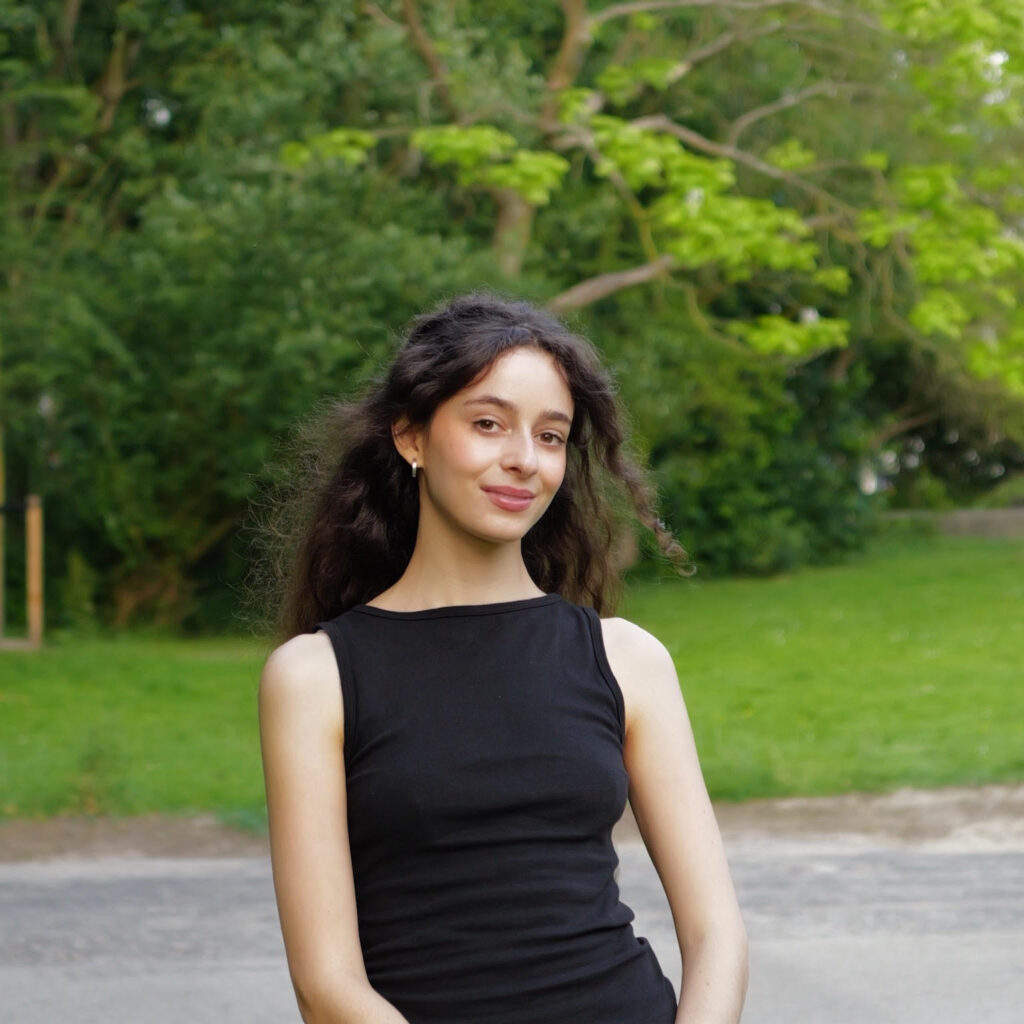
As a Georgian-American storyteller and researcher, Anna Kiknadze brings a multicultural perspective to her work, having lived across the United States, Turkey, Austria, and now the Netherlands. She holds an MSc in Sociology from the University of Amsterdam, with her research focusing on urban sociology, migration, and belonging.
Read more of Anna’s coverage on VATAHA’s website: https://www.vataha.nl/author/anna-kiknadze/