
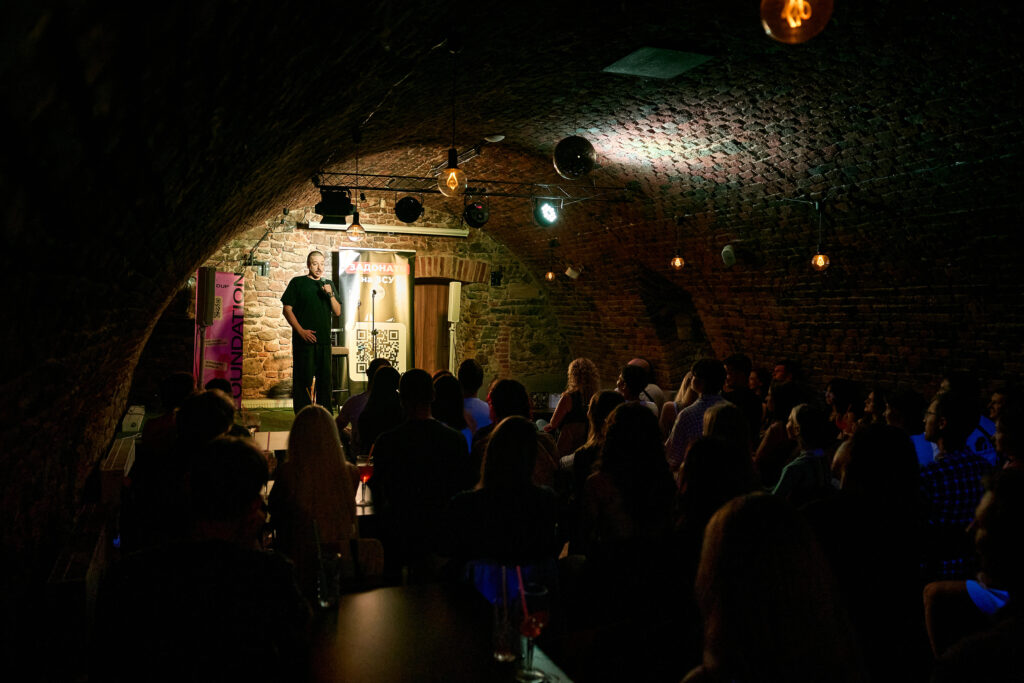
In the beginning, VATAHA’s event manager Nadiia Davydenko simply wanted to bring her favorite Ukrainian stand-up comedians to her new home in Amsterdam.
“Usually, [Ukrainian comedians] perform in other cities, but not here, so I reached out and offered to find a venue so they could just come and perform,” she explains.
Her self-taken initiative has grown into a 2 million Euro fundraising project for Ukrainian defense aid, VATAHA’s most remunerative project. Since the full-scale invasion, Nadiia has organized over 20 Ukrainian comedy shows in Amsterdam and Rotterdam, with up to 200 guests per night.
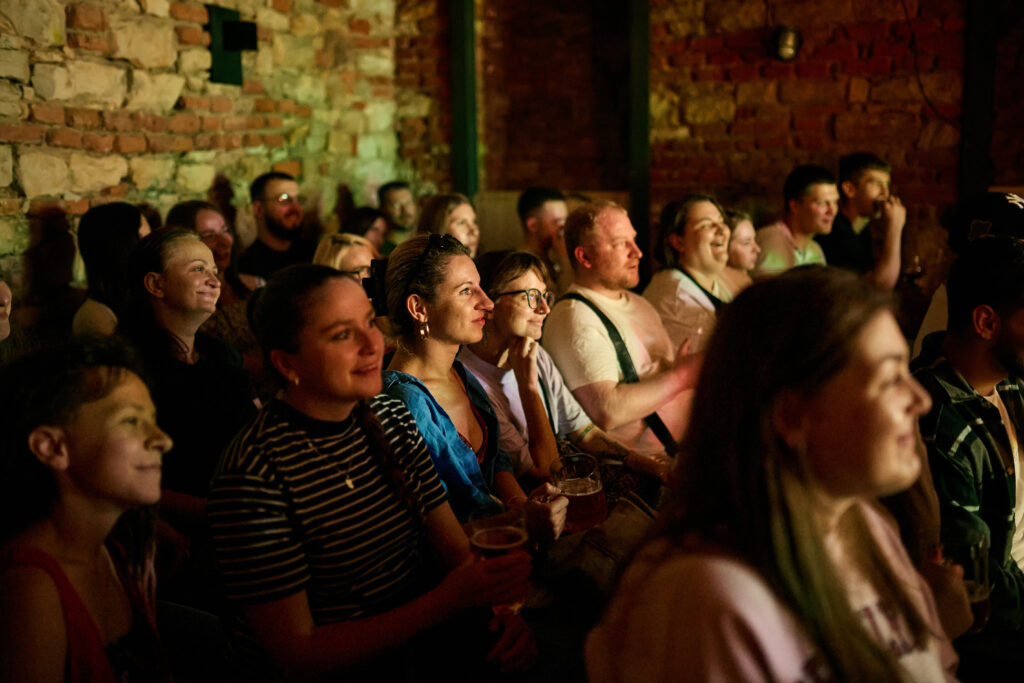
“I still remember the very first show with Serhii Chyrkov. I was anxious, would anyone show up? Would they even be interested in this kind of content?” Nadiia couldn’t believe it: not only was the first show completely booked, but demand was so high she had to organize a second show the same night.
“It was a powerful reminder that the Ukrainian community here deeply needed a good laugh and a chance to reconnect with the part of themselves that is Ukrainian.”
In this first of a two-part interview series, six Ukrainian stand-up comedians share their experiences touring the Netherlands to understand how crucial their work is to not only raising donations but also morale.
The power of laughter
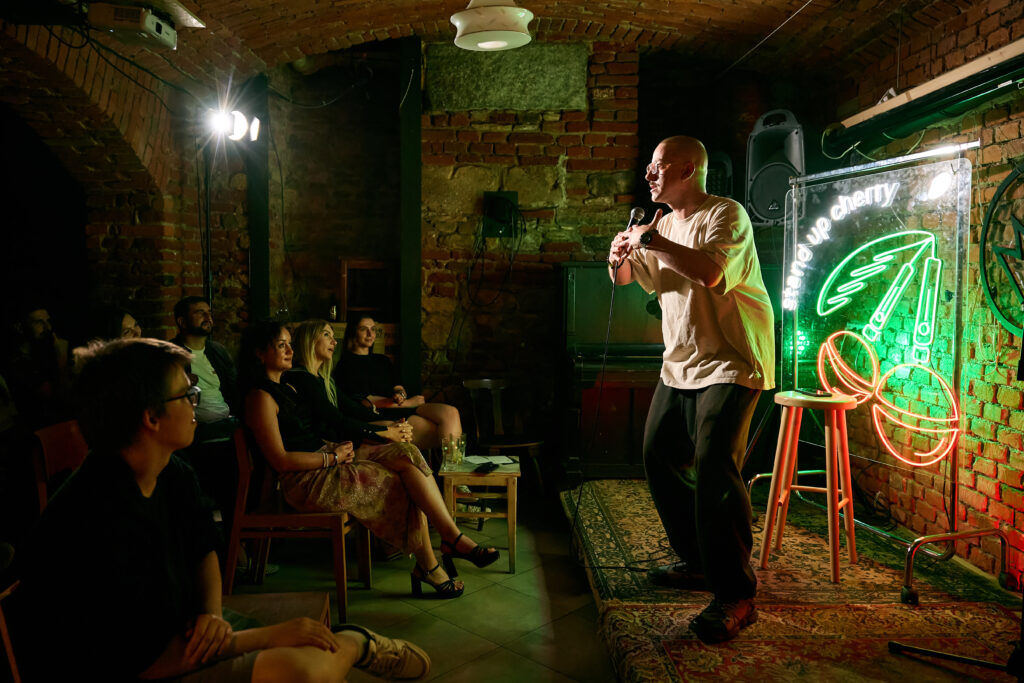
Comedy, like theater, is an essential part of social life, says Svyat Zagaikevich. “Stand-up is unique because the space for it is created very quickly and easily. The simplest setup is a bar, a microphone, a lamp, and a comedian. And there you have a space where you can laugh.”
Lana Chubakha agrees: “Modern comedy is a projection of the experiences of millions, and therefore, by joking about what hurts many people, we become closer and stronger. People come to [the largest comedy club in Ukraine] Underground Stand-Up for emotional release and understanding — they want to hear someone on stage talk about what all of us are going through together,” she says.
“And although many quote the Ukrainian poet Lesya Ukrainka in such situations, ‘so that I wouldn’t cry, I laughed,’ in my opinion we shouldn’t devalue moments of grief and sadness. Stand-up is not about rejecting feelings, but about transforming them.”
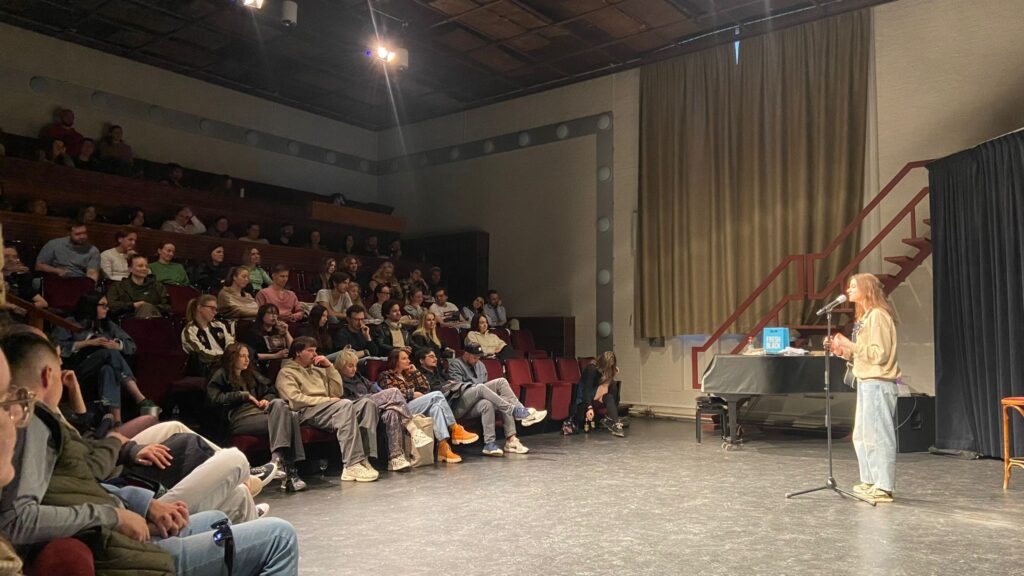
Svyat adds: “[The audience] wants to look at their problems from another angle or see that they’re not alone: here’s a comedian already joking about it, and everyone affected by it is clapping.”
Comedy as therapy
Vadym Dzyunko shares that his audiences have been telling him since the first day of the full-scale invasion that humor helps to not lose your mind. “Whatever anyone says, mental health is very important, and humor is good medicine for it.”
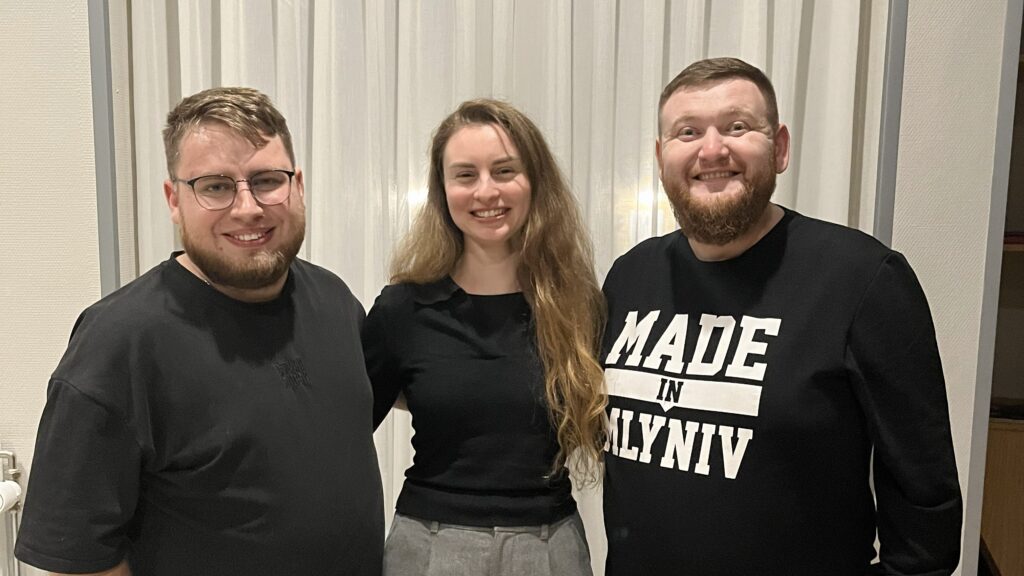
Hanna Kochegura, an early comedy collaborator of VATAHA’s, regards laughter as a powerful defense mechanism. “If you can laugh at something, it becomes less scary and more bearable.”

Lana Chubakha mentions the buzzing (farting) sound of Shahed drones or the fear of taking a shower during a ballistic missile alert as examples. “Joking during hard times is embedded in the Ukrainian genetic code,” Lana explains.
“Our mentality has always been to use humor as a defense mechanism, and this is what human unity and morale are built on today as well. While going through a dangerous and traumatic experience, comedians reflect on it, but in an ironic way.”
Taking it seriously
By transforming seriousness into humor, Ukraine is able to keep living day by day. Anton Tymoshenko argues the daily Shaheds, missiles, and shellings create the conditions for comedy. “Because there aren’t that many options left for the human mind. Either you joke and keep living, or you fully accept the seriousness of it all.”
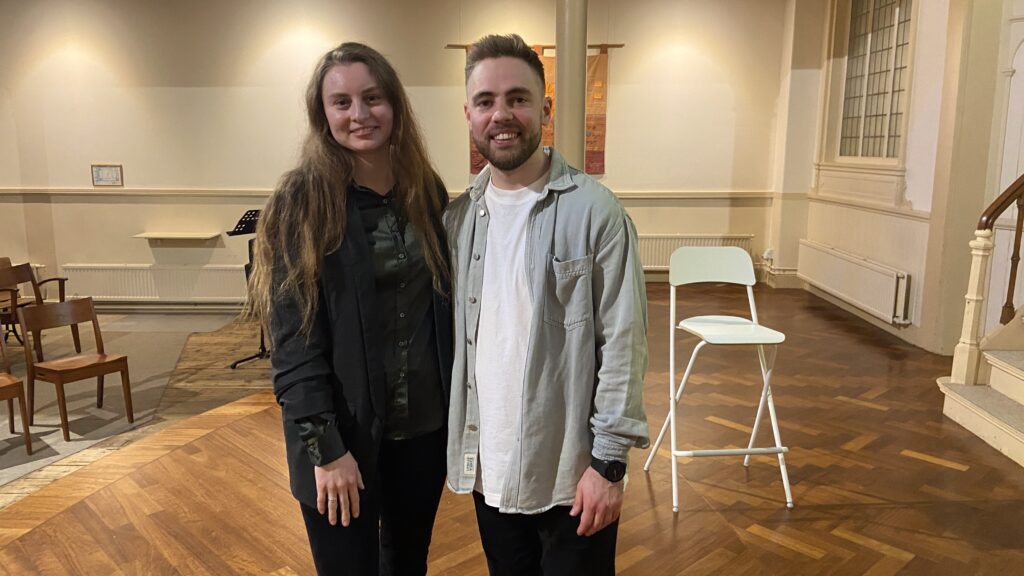
“This entire war — and the way the world has responded to russia — feels like a cruel joke. That’s why Ukrainians try to fill this so-called ‘program’ of the modern world with their own humor. Because taking this world seriously is impossible. If you do take it seriously, then it becomes a broken world — one that shouldn’t exist at all,” he maintains.
Permission to laugh?
Vasyl Baydak shares that it is a “complete lie” that many Ukrainians do not allow themselves to laugh. “A person who forbids themselves to laugh is, in fact, denying themselves a deeply therapeutic act — one that helps them simply survive in such a difficult world.”
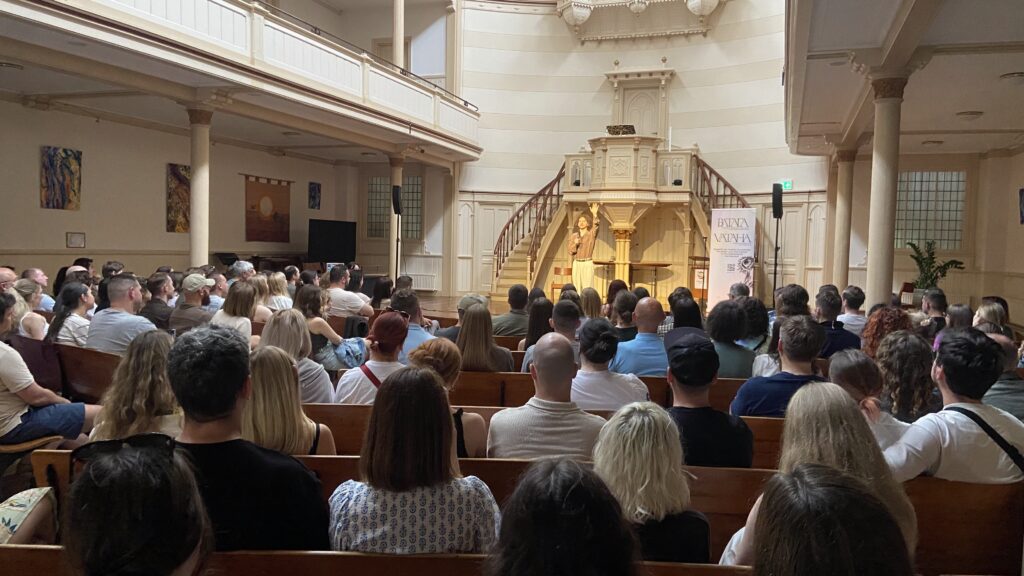
Vasyl even views war as something purely sad as an “amateur” approach to understanding life – as if war is only tragic, or a wedding is only joyful. “But reality is far more complex and multidimensional. In truth, there is often even more laughter during war. It becomes a way to save yourself in those moments.”
“War, in many ways, is more about life,” he continues. “Where there is life, there is laughter. Because war is ultimately about death, and where death is present, life is felt more intensely. You begin to value moments of joy more deeply, and that means you laugh.”
In Part Two of this interview, we discuss crowd work with Ukrainians abroad versus at home, the impact these donation-based shows have had on the Ukrainian community, and the comedians’ motivation to continue their performances.
All six interviewees’ socials here:
Special thanks go to Nadiia Davydenko, for her reporting and conducting the translations from Ukrainian into English, and to IB Promotion, for organizing every tour for each comedian.