
On 21 February, VATAHA gathered young creators in Rotterdam at De Doelen for a zine-making workshop. The event was dedicated to commemorating the fourth anniversary of the full-scale invasion of Ukraine on 24 February, yet we did not want to turn this date into a theme or a headline to consume.
For Ukrainians, it is a painful day, so we chose to mark it with the opposite of destruction, with what VATAHA does best: culture and creation. At the same time, we wanted to hold space for stories that rarely make it into headlines: experiences of a war that, for many of us from the Donetsk region, began 12 years ago in 2014.
The zine’s purpose was clear: not to create a journalistic project or record history ‘correctly’ or even to collect written testimonials. Instead, we wanted to build a collective space where people from the region could work through memory in their own ways and shape it into a shared, physical object. Over one intensive day of writing, cutting, listening, and assembling, our first zine took shape.
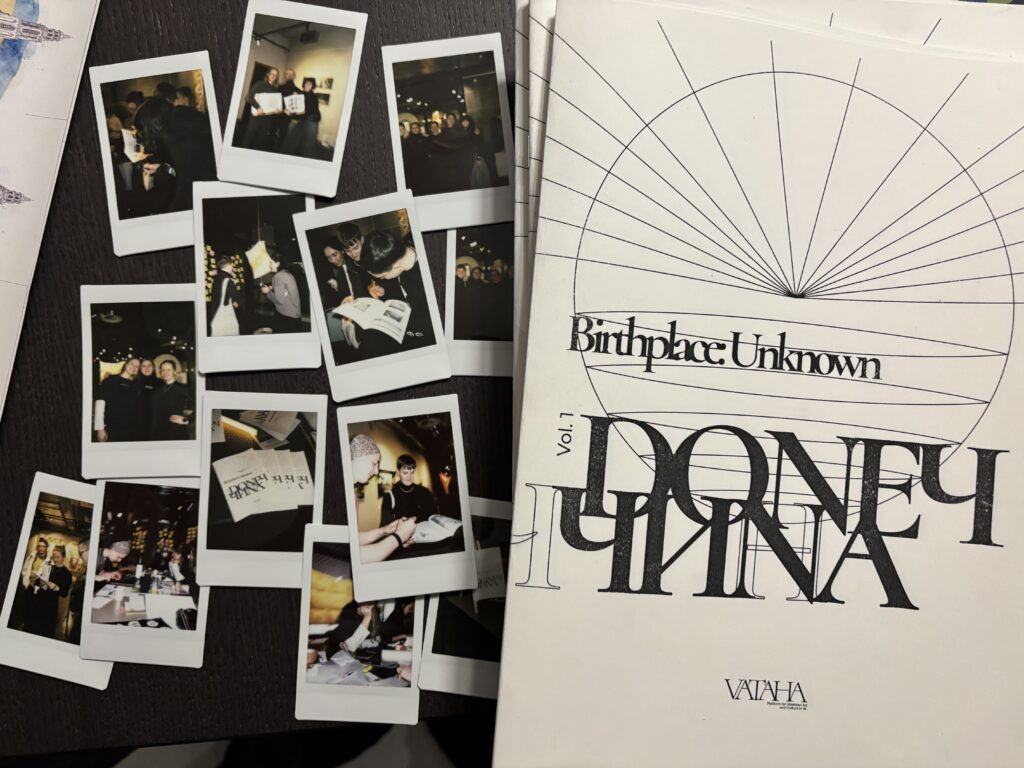
Donechchyna: a zine made from routes
We began with a title that felt large enough to hold our intention: Birthplace: Unknown (Vol. 1 – Donechchyna) – a series that could return each year to one of Ukraine’s temporarily occupied or liberated territories. It felt like a way to come back to 24 February without turning it into a performance. Not a theme to consume, but a quiet point of grounding, and to stay close to what is often difficult to hold alone. The magazine title originates from my own story of a Dutch municipality not recognizing my place of birth in my ID document, listing my hometown not as “Makiivka” but instead as “birthplace unknown”. I was never given an explanation why but my guess is that it is due to the russian occupation.
During the workshop, we focused on staying present and making something for the sake of home and memory. The kind of memory that does not exist as an archive, but lives in bodies, in language, in texture and sound. It was essential that the workshop function not only as a production site, but also as a site of care – a container for stories, free from the pressure of perfection and performance.

Why did the name change?
As the day unfolded, something became clear: everyone in the room carried lived ties specifically to the Donetsk region, not just the wider Donbas area, the region we originally thought we would focus on.
We spoke about how Donbas holds many meanings and is never a single story. Donbas can describe the territories of Donetsk, Luhansk, and parts of the Dnipro region. We realized it carries more than we could responsibly hold in one issue. We did not want to flatten a region into one voice, especially not in the first volume. These places deserve their own zones, their own constellations of voices, and their own time. So we changed the name. The first zine became Донеччина – Donechchyna.


Routes / маршрути: the theme that found us
We did not choose a subtopic in advance. We wanted it to emerge naturally from the group – from what felt urgent. The word that kept returning was routes / маршрути.
Routes are the obvious things: roads, trains, stations, evacuation lines, border crossings, internet paths, family trajectories. But routes are also less visible movements: how memory travels; how language shifts when you have been away too long; how the body remembers directions even when you feel you do not, or do not want to. Routes describe what it means to live “in between” – between places, between dates, between what happened and what it felt like.
This theme allowed us to remain in complexity and hold contradictions without resolving them. The region can feel like both home and estranged territory – industrial yet fragile, silent and noisy, close and impossibly far at once. Routes also helped us speak about how memory does not arrive as a straight timeline. It comes in fragments: in smells, in phrases, in textures or insider jokes.

Making as an act of care
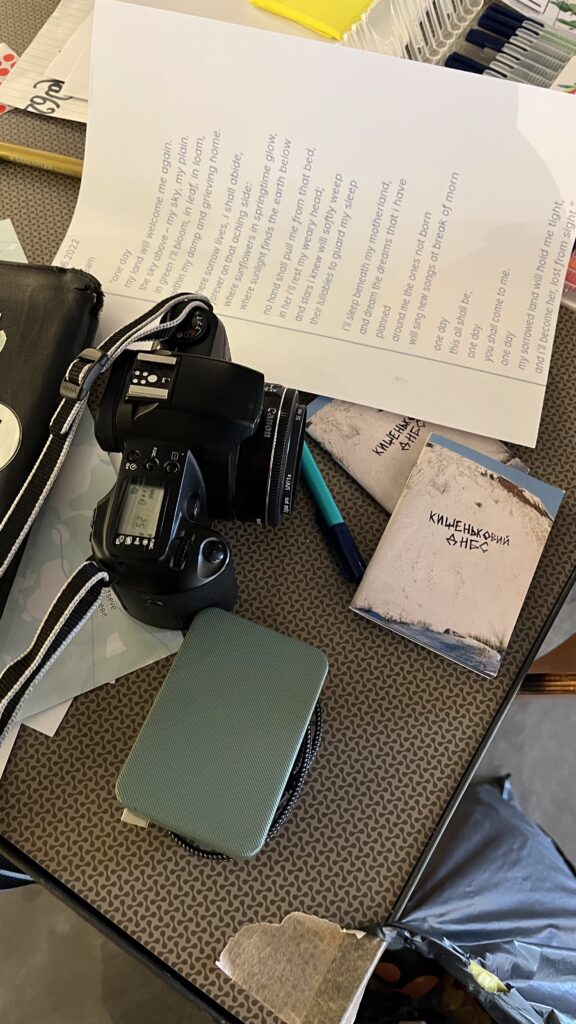
We used simple, DIY publishing methods: writing, collage, drawing, scanning, photocopying. The zine became a creative experiment in lowering perfectionism and inviting young creators to contribute in ways that felt possible, a list instead of a confession, a map instead of an explanation, an image instead of a paragraph.
Everyone arrived with stories in mind but without prepared works. The zine grew out of what happened in the room: getting to know one another, listening carefully, exchanging, and finding the small courage to put something on paper and let it be seen.
In the evening, we invited a public audience to join us as we shared the finished zine and reflected on the process. Holding the first version in our hands, we also carried something invisible: the experience of collective attention. For now, we hold Donechchyna as it is, not a final statement, not a complete record, not a perfect object, but a collective gesture made of routes.
On a personal note, I feel incredibly lucky to have facilitated this workshop and zine. I come from the Donetsk region and have not been able to return since 2014. The distance feels heartbreaking. Sometimes I realize that the images in my mind are beginning to blur — the streets, the places, even my grandparents’ house. I am slowly forgetting where I grew up.
We also lost many of our family memories there. When my grandparents moved away, no one imagined it would be for so long. We all planned to return. But time stretched on, and what we left behind slipped away. Now the memories feel scattered, and all we can do is gather them again, piece by piece.
This workshop felt like a warm hug, like holding a small jar and placing fragments of memory inside, not to preserve them perfectly, but to keep them in sight. I used to think memory was something we simply have, stored inside us. This experience reminded me that memory is also something we do. We build it together, imperfectly, and in real time.
What’s next
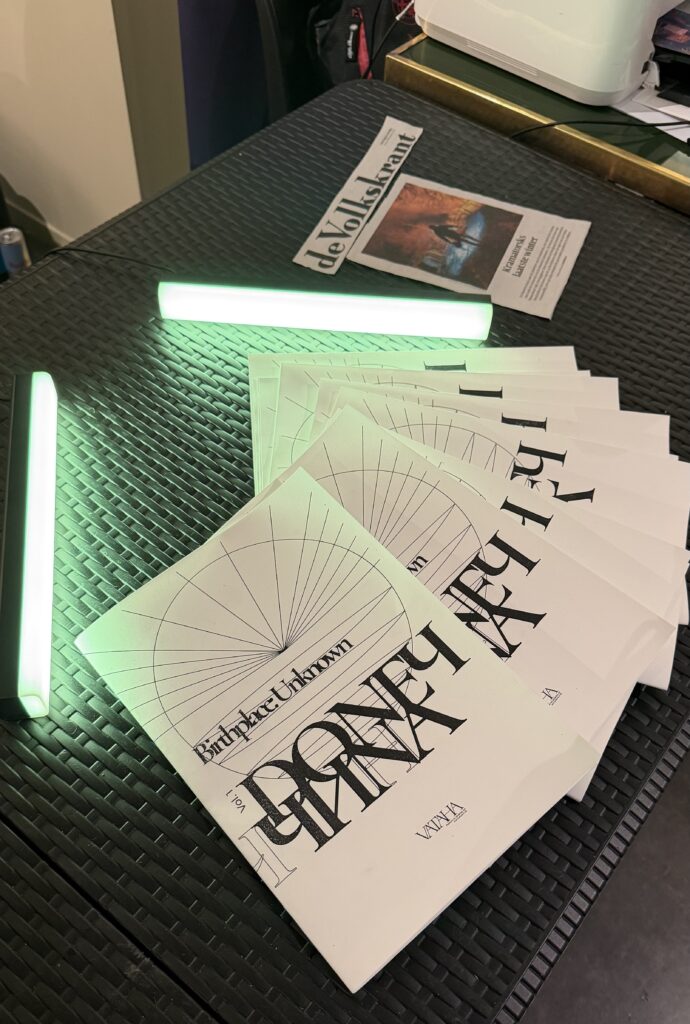
Donechchyna is the first step in a longer series – a pilot version made possible through donations from Run for Ukraine 2025, supporting young artists in the Netherlands. With this first issue, VATAHA aims to build a sustainable platform that focuses on different temporarily occupied regions of Ukraine, centering the voices of people in the Netherlands who carry lived ties to home.
VATAHA would also like to extend its gratitude to all the contributors to the zine: Varvara Konstantynova, Veronika Matkovska, Anastasia Prokofieva, Ivan Frolov, Maksym Frolov, Viktor Zasypkin, Maksym Yakushkin.
The workshop took place inside the exhibition DO NOT CROSS at De Doelen studios, curated by Nick Verschoor, supported by CBK Rotterdam. The workshop would not be possible without the support of De Doelen and CBK Rotterdam.
From March onwards, you can buy the first edition, translated to English, of the zine at TENT Rotterdam.
If you would like to support future issues, consider donating to VATAHA.