
After attending IDFA – the International Documentary Film Festival Amsterdam 2025 – our editorial team wondered: why does it matter today to watch Ukrainian films, and why does it matter that we do so via legal distributors and platforms?
As Ukrainian cinema increasingly appears on international stages and reaches diverse audiences, it no longer functions simply as ‘national cinema’. It becomes a site of necessary encounter, a way to engage with a country and its people who are actively fighting for the right to speak in their own voices and to shape their own narratives.
As shorter days and the Dutch weather invite us indoors, the familiar ritual of watching films can become more than seasonal comfort. In the current historical moment, cinema can also serve as a form of witnessing, a shared space of reflection, and, in the case of Ukrainian filmmaking, an act of resistance.
With our team’s selection of both documentary and narrative Ukrainian films, we invite you to explore Ukrainian cinema ethically and consciously through streaming platforms such as Takflix.
Why watching Ukrainian films matters now
Cinema is never neutral, especially in times of war. For Ukraine, filmmaking has become a way to record realities constantly under threat of erasure. To watch Ukrainian films today is to take part in a fragile but essential chain of memory. These works challenge the simplifications often produced by mainstream news and social media. They offer something slower and more complex: intimate stories, ethical questions, quiet forms of courage, and contradictions that do not fit into easy narratives of heroism or victimhood.
Reasons to support Ukrainian film distributions
Watching Ukrainian films on legal platforms, attending screenings, and supporting festivals that programme Ukrainian work are not just passive consumerism; they are ethical choices.
By choosing Ukrainian films, viewers actively resist the cultural marginalisation of a country at war. They help ensure that Ukrainian filmmakers are not reduced to a temporary focus on war, but are recognised as long-term contributors to European and global cinema. This support matters materially as well: distribution revenue, international co-productions, and festival visibility can influence whether filmmakers continue their work at all.

Documentary and fiction: Two ways to engage with reality
Ukrainian cinema today speaks powerfully through both documentary and narrative forms, and the difference between them seems to lie in their strengths.
Documentaries often work closely with the fragility of the present. They create spaces where reality can be observed, where the audience can actively engage with it. Ukrainian documentary filmmakers have developed a language of care – one that does not utilize spectacle but is instead based on patience, trust, and proximity. These films do not try to explain, for example, war to us; they just allow us to sit with its presence in everyday life.
Narrative films, on the other hand, create emotional connections that allow other forms of truth and realities to be visible. Fiction films often approach what is challenging to document directly: trauma, memory, responsibility, guilt. In this way, Ukrainian fiction cinema, working through metaphors and atmosphere, allows audiences to dive deeper into the historical, political, social, and just everyday layers of life.

Our editorial team’s top picks
Militantropos (2025) dir. Yelizaveta Smith, Simon Mozgovyi, Alina Horlova
Militantropos refers to “a persona adopted by humans entering a state of war.” There wasn’t a dry eye in the house. Aesthetically stunning, and emotionally devastating, this film explores how humans adapt to, survive, and live in war. Tender, human moments juxtaposed with grimness and grief. The Directors of Photography take us to the front lines (where we witness tense moments in dark trenches, as well as soldiers goofing off in a lake), but also show us how war touches and changes everyone. This film will haunt me for a long time.
Recommended by Anna Kiknadze
Timestamp (2025), dir. Kateryna Gornostai
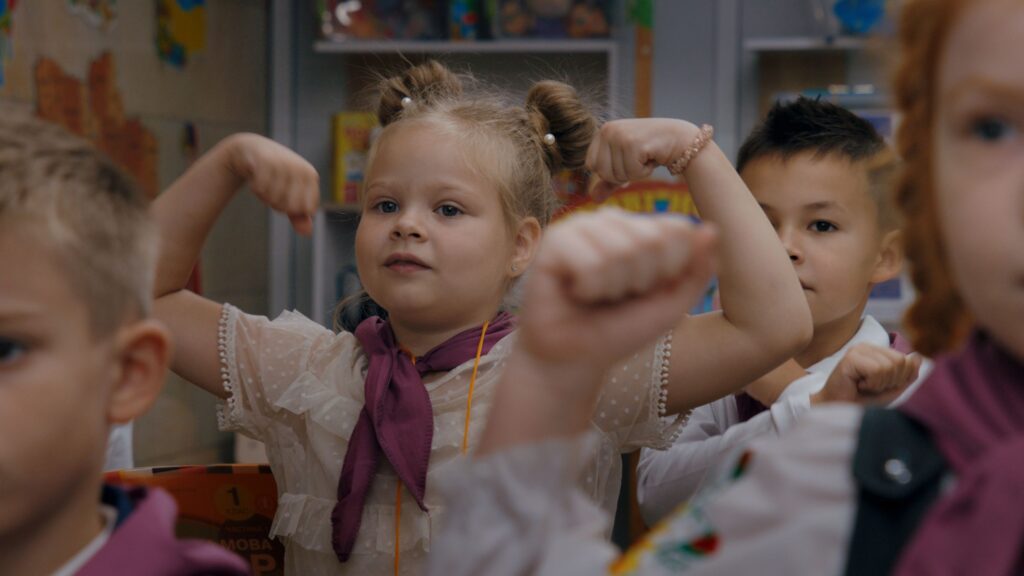
There isn’t a single shot of warfare in Timestamp, yet the impact of war is felt in every scene. The film follows students all over Ukraine through one academic year, from the usual milestones of first day of school [перший дзвінок] to the last day of school [останній дзвінок] and graduation, each rite of passage touched by the quiet, persistent shadow of a war that never strays far.
A time stamp refers to a specific moment in time – one school year – but also the practice of writing down the time on a tourniquet when it’s applied, something every Ukrainian child learns to do at school.
From teachers teaching on Zoom in what remains from a school after a missile attack to pre-schoolers learning how to recognise hand grenades in their toys to a school relocated to a subway station, the film becomes a tender, heartbreaking tribute to education itself, its fragility, resilience, but also hope, the hope it brings for a different future.
Recommended by Olena Poburko
Nice Ladies (2024), dir. Mariia Ponomarova
I watched Nice Ladies with my mother and grandmother, which felt like the perfect way to watch it. A team of older (50+) Ukrainian cheerleaders from Kharkiv prepares to compete for the European championship. Following the russian invasion, one of the team members leaves Ukraine for the Netherlands. A complex, at times funny, often heartbreaking movie: exploring womanhood, trauma, friendship, and the tensions between those who leave and those who stay.
Recommended by Anna Kiknadze
My thoughts are silent (2019), dir. Antonio Lukich
This film feels like a quiet, bittersweet road trip through both Ukraine and through a fragile mother-son relationship. It gently balances awkward humor with loneliness and tenderness. It made me think about migration, small dreams, and the strange distance that can exist between people who love each other the most. It’s understated, funny, and unexpectedly touching.
Recommended by Dasha Lohvynova
Pamfir (2022), dir. Dmytro Sukholytkyy-Sobchuk
Pamfir feels like a slow-burning descent into something dark and inevitable. Watching it, I felt a constant tension. What struck me most was how physically the film is made: the mist, the blood, the cold forests, the ritual masks – everything feels close and tangible. At its core, it’s a story about love and responsibility, and how devotion to family can push someone into dangerous decisions. There’s something almost mythical about Pamfir himself – a man trying to be good in a world that doesn’t allow purity. The film feels brutal but deeply human, turning a personal story into a dark modern fairytale.
Recommended by Dasha Lohvynova
The cozy season as a space for ethical attention
The idea of the ‘cozy season’ does not have to be shallow. It can be reclaimed as a time for slower looking, deeper listening, and more responsible viewing. While the world outside turns colder and darker, cinema offers a way to stay emotionally and intellectually awake.
Ukrainian films demand that kind of attention. They might not always resolve into comfort, but they offer something more durable: a sharper sense of reality, an ethical imagination, and a deeper connection to a country that continues to fight for its territory, people, and voice.
Check out our interview with Nice Ladies director Mariia Ponomarova:
See also our conversation with Mariia on boycotting IFFR 2025: